
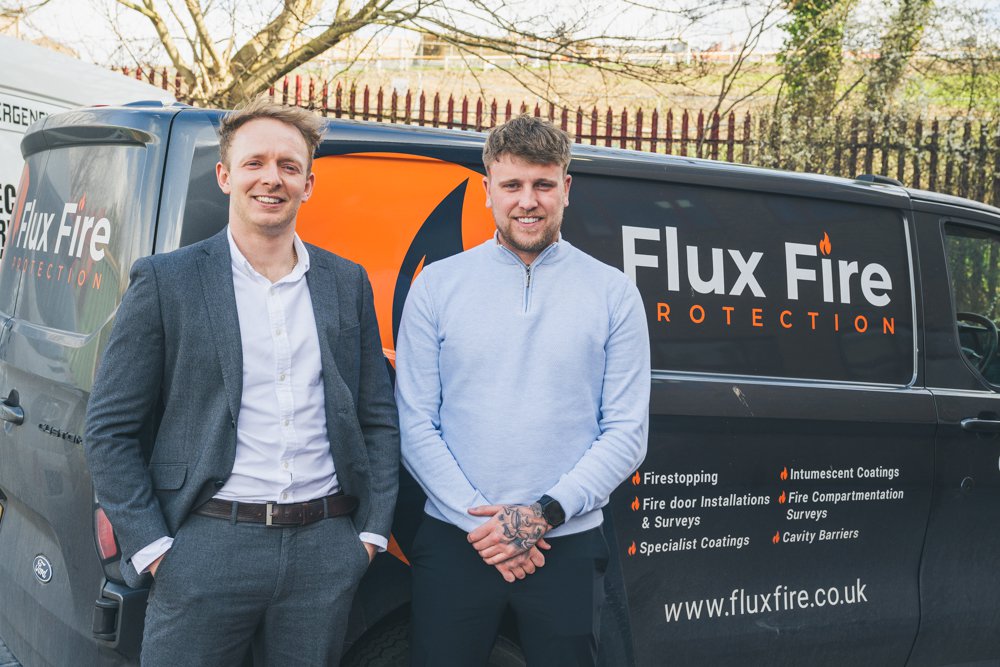
Romero Insurance talks to Danny and Lee from Flux Fire Protection
Romero’s Client Stories project identifies unique businesses based in Yorkshire with diverse insurance needs. Each business has a storied insurance history and benefits from close contact with their dedicated handler. The Client Stories campaign demonstrates how insurance professionals can positively impact the welfare of local businesses.
Flux Fire Protection in Cleckheaton delivers passive fire protection nationwide. The company was founded by Danny Bell, Commercial Director – with Operations Director Lee Andrews joining shortly afterwards. Together they have built a thriving business which is growing rapidly.
By harnessing long hours, hard work and their industry connections, the two entrepreneurs are taking on bigger and bolder projects each year. Their passive fire protection solutions are subjective for each build – a flexible approach unique to the sector, which demands expertise and innovation. Such flexibility and rapid growth requires close communication with an insurance broker, checking and updating the limitations of their policy.
Romero Insurance Brokers visited the offices of Flux Fire Protection to discuss the business’s origin with founder Danny Bell. We also explore the range of products available from Flux Fire, and how Lee Andrews thwarted a cyber breach.
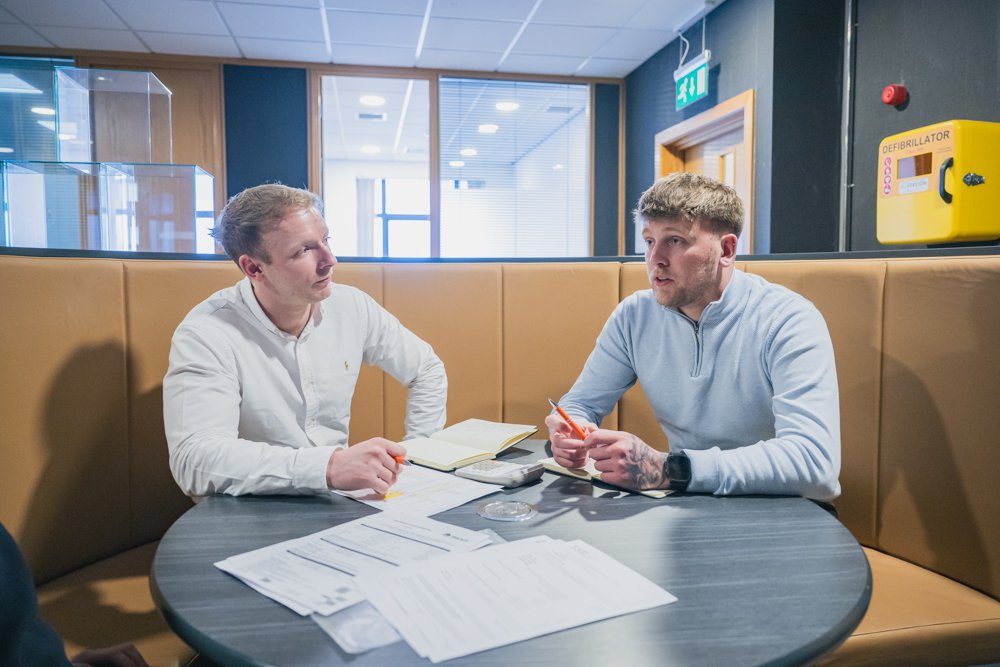
Lee Andrews, Operational Director at Flux Fire Protection
What did you do before Flux Fire Protection?
Danny: So I’ve been in Quantity Surveying since I was 16 years old. In 2012, I undertook a quantity surveying apprenticeship, which was a cross between being an accountant, a lawyer, and a project manager but all within construction. I mainly managed the volumes of materials for construction contracts, working on Morrison’s supermarket new builds. Then as soon as I was 17, they chucked me in a company car and said: You are going to Wales – and there I remained until 2020, when everything shut down due to the pandemic.
My company put me through university at Leeds Beckett in 2017. This was in the wake of the Grenfell tower fire disaster, which is what I based my dissertation upon. The disaster was a hot topic that sent shockwaves through the entire construction and build environment industry. I researched everything – who was at fault, how it could have been prevented, who was the fire stopping contractor, how the council’s planning department allowed this cladding and how long it took the fire brigade to arrive. There was so many different moving parts, and I thought it was a cracking industry to get more involved with.
The pandemic was an opportunistic time for the construction sector. Many premises were closed so businesses took the time to conduct refurbs and updates. There was a big work from home culture at the time, it was the perfect situation to set up a new business. Hence, I set up Flux Fire Protection and jumped in with both feet.
Lee: My story is very similar to Daniel’s. I only lasted three weeks at university before I knew it wasn’t for me. I did an apprenticeship in construction, and quite quickly I realized that work within fire protection was more interesting and placed less strain on my body. I specialised in dry lining, fire stopping and compartmentation, all areas of passive fire protection.
I then worked as a subcontractor; I actually was hired by Danny before he approached me about joining the business. I joined after Year One – Danny contacted me because he had a lot on his plate and wanted someone to manage the labour and operational side of the business. And with my experience in supplying and installation, we both felt I was a perfect fit.
What’s the history of Flux Fire Protection?
Danny: It very much started out as me and two other guys in a van working maximum hours for less than minimum wage. We would source and install passive fire protection systems. Our first project was Leighton Hospital in Crewe, involving 5am starts, working Sundays, with 8pm finishes. This involved sealing voids to prevent the spread of fire and smoke.
That one project filled our first year and fuelled our growth – it was a great client and a great opportunity. Year One we saw £100k turnover, which is a net loss – similar to most businesses, but it enabled us to achieve the accreditations and get the ball rolling.
In Year Two we picked up more projects, Leed came on board as Operations Director and we hit the ground running. We developed our systems, fleshed out our services, and saw a £550k turnover. We then grew from there – Year Three was £2.1million, Year Four was £3.3million – and now into Year Five we are doing well.
Some of the larger projects we’ve completed include the Nissan car manufacturing garage in Sunderland, Nottingham City Hospital and York Science Park.

What variety of services do you provide at Flux Fire Protection?
Danny: The services we provide are subjective to each business. With each case, we recommend different products and supply different types of passive fire protection.
There are five arms to our business which determine our service offerings. The first is ceilings; involving holes caused by pipes, ductwork or cables running from one room to another. This can compromise your dividing walls, so sealing these holes and your lights will reduce the time it takes for smoke to spread through a building.
Second is cavity fire barriers which involves hanging a flexible fire curtain. Managing void spaces is key to slowing fires and improving the fire ratings of large rooms. Think attics or corridors or stairwells, commonly found in care homes.
Third is fire doors, both the assessing of fire doors and installing. Inspections, maintenance and new installations are all regular and necessitated. A fourth area of services we provide are intumescent coatings. New builds require steel work for frames, but in the event of fire this steel can melt and warp, compromising the structural integrity of the building. Our intumescent paint products provide a thick coat that insulates the steel work from heat. The trick when painting exposed steel beams is to not make it look out of place, and keep it decorative.
Another area we specialise in is building assessments and compartmentation. We will provide an assessment of the ceilings and floors, any void areas such as attics and cupboards, and determine how quickly fire could spread through the premises. This service includes recommendations for remedial actions – which then leads to providing our passive fire stopping products.
What key relationships benefit your business?
Lee: We have relationships with the suppliers, importantly with those who manage projects and understand the quantities of materials. We try to order in bulk and use the same supplier for multiple projects to save on costs and delivery times.
Other key relationships would be with the manufacturers. For example if an architect specifies a requirement, there could be a broad spectrum of products which match the specifications. Maintaining a dialogue with manufacturers helps ensure that what is specified on projects has the relevant certification. Manufacturers dictate the specifications, and we need to fully understand their requirements in order to remain compliant.
Danny: We often interact with the end user, such as the building owner, as well as the main contractor. They employ us as the professionals to provide recommendations and remain compliant, and so we need to sustain these relationships to provide the best service possible. Whether the job is compartmentation or to reduce the fire spread speed, Lee and the team will look at the most cost effective way of doing it.
Aesthetics is a huge concern for our customers. When it comes to sealing or fire curtains, customers tend to think passive fire safety will make their units look ugly. It’s important to build a relationship with clients and that they trust us. We photograph everything, which helps prove to clients the final result will look good. All the photographs are then included in a report, which is useful incase the premises are handed over. So while the fire stopping measures functionally protect people and assets, it’s not hard to make it look aesthetically pleasing at the same time – it’s about taking pride in our work.
What financial pressures are challenging your business?
Danny: We don’t hold stock which I would expect is a prominent financial challenge for most businesses. But in the construction industry, cash flow and deliverable risk are the biggest financial factors.
In this industry, everyone wants super long payment terms. People will ask to be invoiced 45 days to 60 days after the month-end following the project’s completion. Projects completed in March can sometimes not see payment until mid-June. Whereas we are paying for labour on day one and are purchasing materials, so balancing the finances can be a challenge.
Lee: Finding labour has never really been a challenge. Getting the necessary trades in place is subjective to the package we are delivering to a client. Time and deadlines can pose a challenge too – new builds provide more time than remedial works on preexisting properties, because if action is needed as ordered by the fire brigade, then that’s two or three weeks the business faces interruption. Some jobs want the work done immediately, some offer a 6 month lead time, so the challenge of sourcing labour can vary.
Juggling clients can be tough; managing multiple projects at a time. Flux Fire operates countrywide, including Scotland and Wales, so organising staff and travel is a financial burden. But that’s the cost of a growing company – we’ve just opened a new office in London where there are many opportunities. I‘m looking forward to the challenge.
How did you begin to be insured by Romero Insurance Brokers?
Danny: We decided to be insured by Romero Insurance Brokers upon inception of the business. My previous employer were insured by Romero and never had an issue, so they were my first port of call. Romero has always been accommodating toward us – Flux Fire has a diverse range of needs as we offer an ever-changing offering of services.
A huge service Romero Insurance provides us is engaging client PQQs. PQQs are pre-quality questionnaire forms which are filed when we pick up a new client who require some information about us. The questionnaire involve hundreds of questions which requests how we operate, our health and safety policy, our accreditations, and also insurance. The insurance section is very particular and specialist, involving the exclusions on our policy and our limits. Because of policy changes and the specificity of the questions, we request that a team member from Romero overlook that section for us. Our business development manager usually leans on the expertise of Jenny Wills, Head of the SME team at Romero Insurance Brokers, who regularly support us on that front.
Whether it’s a one page proof of cover or a 20 page pre-quality questionnaire, the Romero inbox is always open and we receive a prompt helpful reply. And because of the fast spontaneous turnaround in our sector, a dedicated responsive insurance broker is essential for us.
Do you manage your cyber risks?
Lee: We have suffered our own cyber attack previously. Invariably it happens when the Director, Danny, is on holiday trying to enjoy themselves and without PC functionality.
Someone tried to send through an invoice to our accounts department, from my email address! They were almost successful and our business almost paid out, if not for the awareness of Natalie in Accounts. She called me and asked if I’d sent through an invoice at 2am in the morning. The false invoice was for £16,000, and if it wasn’t for the odd time, the business may have paid it.
After some investigation, it turns outs, years before, my work email was hacked – but the perpetrator didn’t act upon it immediately. They had then used a VPN to host an active conversation with Natalie, sending multiple emails form my email address. I had no knowledge because they used a ruling where the messages would not go into my inbox but into a hidden folder.
Cyber attackers are very sophisticated, a person at home behind a laptop are now more dangerous than ever. Thankfully it was caught and we didn’t approve the invoice, but it was a close call. Upon discovery we contacted our provider to do a full reset and sweep of our systems. Since that breach, we’ve been actively mitigating risks, we’ve put in place two-factor authentication, and all invoices need to be signed off by multiple individuals with physical authorisation. We are looking into more in-depth cyber training, such as a seminar to our staff and how to spot more advanced phishing attempts.
Danny: Many may think cyber is just a GDPR tick box exercise, but in the event of a security breach, you quickly realize everything is hosted online. A cyber policy costs us just £400, it’s not a massive premium and will covers us for our cyber risks.
What’s next for Flux Fire Protection?
Danny: We’ve just opened our London office, so we are excited to expand into the capital and pick up more clients. Interestingly, London awarded 20 times more value in construction contracts in 2025 than every city in Yorkshire combined, which to me is colossal. Think how many big cities Yorkshire has, and London is still head and shoulders above us.
Going forwards, we are also looking at how we can better support existing clients. I want to improve our promotion and documentation of case studies, which will help us pick up more clients in all regions.
Thank you to Danny and Lee for their time, fitting us into their busy schedule. We really enjoyed discussing the specifics of their policy and learning more about fire protection scenarios. We wish your business every success in the future.